
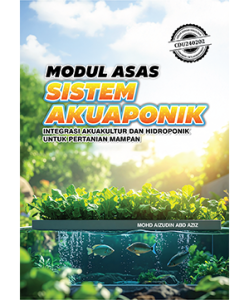
MODUL ASAS SISTEM AKUAPONIK: INTEGRASI AKUAKULTUR DAN HIDROPONIK UNTUK PERTANIAN MAMPAN
Keywords:
Akuaponik, Pertanian Mampan, Produk Hiliran IkanSynopsis
Abstrak: Modul Asas Sistem Akuaponik: Integrasi Akuakultur dan Hidroponik untuk Pertanian Mampan merupakan panduan praktikal yang komprehensif untuk sesiapa sahaja yang ingin memulakan atau memahami sistem akuaponik moden. Dengan penyusunan secara sistematik berdasarkan pengalaman lapangan dan penyelidikan terkini, modul ini merangkumi komponen asas sistem akuaponik, pemilihan ikan dan tanaman yang sesuai, penjagaan kualiti air, pengurusan kos serta penghasilan produk hiliran seperti ikan pekasam. Modul ini juga mengetengahkan aplikasi sebenar melalui projek komuniti di Paya Bungor dan SMK Gambang, menjadikannya rujukan yang relevan untuk pelajar, komuniti, pendidik serta pengusaha mikro dalam bidang pertanian lestari.
Modul yang diperkaya dengan infografik, jadual dan panduan langkah demi langkah ini bukan sahaja sesuai untuk pembelajaran di bilik darjah dan bengkel latihan, tetapi juga sebagai rujukan utama dalam usaha memperkasakan keusahawanan sosial berasaskan makanan dan inovasi hijau.
References
Somerville, C., Cohen, M., Pantanella, E., Stankus, A., & Lovatelli, A. (2014). Small- scale aquaponic food production: Integrated fish and plant farming. FAO Fisheries and Aquaculture Technical Paper No. 589. Rome: FAO. https://www.fao.org/3/i4021e/i4021e.pdf
Rakocy, J. E., Masser, M. P., & Losordo, T. M. (2006). Recirculating Aquaculture Tank Production Systems: Aquaponics—Integrating Fish and Plant Culture. Southern Regional Aquaculture Center Publication No. 454.
Love, D. C., Fry, J. P., Li, X., Hill, E. S., Genello, L., Semmens, K., & Thompson, R. E. (2014). An international survey of aquaponics practitioners. PloS one, 9(7), e102662.https://doi.org/10.1371/journal.pone.0102662
Lennard, W. A. (2012). Aquaponics – The Basics: A Simple Guide to Aquaponic Systems and How to Build Them. Aquaponic Solutions, Australia.
Tyson, R. V., Treadwell, D. D., & Simonne, E. H. (2011). Opportunities and challenges to sustainability in aquaponic systems. HortTechnology, 21(1), 6– 13. https://doi.org/10.21273/HORTTECH.21.1.6
Endut, A., Jusoh, A., Ali, N., Wan Nik, W. B., & Hassan, A. (2010). A study on the optimal hydraulic loading rate and plant ratios in recirculating aquaponic system. Bioresource Technology, 101(5), 1511–1517.
Nelson, R. (2008). Aquaponic Food Production: Raising Fish and Plants for Food and Profit. Nelson and Pade, Inc.
Palm, H. W., Knaus, U., Appelbaum, S., Goddek, S., Strauch, S. M., Vermeulen, T., ... & Kotzen, B. (2018). Towards commercial aquaponics: a review of systems, designs, and practices. Aquaponics Food Production
Cham.Springer, Systems. https://doi.org/10.1007/978-3-319-92375-3_3
FAO. (2022). The State of World Fisheries and Aquaculture 2022: Towards Blue Transformation. Rome: Food and Agriculture Organization of the United Nations.https://www.fao.org/3/cc0461en/cc0461en.pdf
Malaysian Standard Department. (2021). MS 2630: Aquaculture – Good Aquaculture Practice (MyGAP) for Aquaponics. Department of Standards Malaysia.
Published
Categories
License

This work is licensed under a Creative Commons Attribution-NonCommercial 4.0 International License.