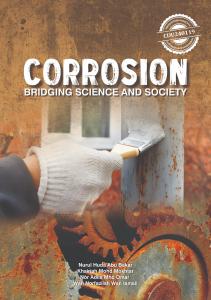
CORROSION: BRIDGING SCIENCE AND SOCIETY
Synopsis
Corrosion is an ever-present challenge that silently erodes our infrastructure, impacts economies, and poses risks to public safety and the environment. From rusting bridges to deteriorating pipelines, the consequences of corrosion extend far beyond mere material degradation. Corrosion affects the very fabric of modern society. Corrosion: Bridging Science and Society seeks to explore this unescapable issue by connecting the scientific principles of corrosion with its real-world implications.
This book is designed to serve as a comprehensive yet accessible guide for beginners such as students and postgraduates in engineering, materials science, and related fields, as well as professionals, policymakers, and anyone interested in understanding corrosion from both technical and societal perspectives. It begins with the fundamentals of corrosion, explaining the electrochemical processes that drive material degradation in a clear and approachable manner. Next, it delves into the various types of corrosion, highlighting their mechanisms and real-life manifestations with practical examples.
Beyond theory, this book emphasizes preventive measures, showcasing cutting-edge techniques and best practices to mitigate corrosion in industries and everyday life. Most importantly, it examines the broader impact of corrosion on society, including its economic costs, threats to critical infrastructure, and environmental consequences. A dedicated discussion on public awareness highlights the need for education and proactive policies to combat this silent menace.
Whether you are a student encountering corrosion studies for the first time, a postgraduate researcher deepening your knowledge, or a professional seeking practical insight, this book provides a balanced blend of foundational science and real-world relevance. The goal of Corrosion: Bridging Science and Society is not only to inform but also to inspire action—whether through better engineering solutions, smarter regulations, or increased community engagement.
References
Al-Amiery, A., Isahak, W. N. R. W., & Al-Azzawi, W. K. (2024). Sustainable corrosion Inhibitors: A key step towards environmentally responsible corrosion control. Ain Shams Engineering Journal, 102672.
Al Jahdaly, B. A., Maghraby, Y. R., Ibrahim, A. H., Shouier, K. R., Alturki, A. M., & El-Shabasy, R. M. (2022). Role of green chemistry in sustainable corrosion inhibition: a review on recent developments. Materials Today Sustainability, 20, 100242.
Bakar, N. H. A., Ali, G. A., Ismail, J., Algarni, H., & Chong, K. F. (2019). Size- dependent corrosion behaviour of graphene oxide coating. Progress in Organic Coatings, 134, 272-280.
BYJU’S. (n.d.). Galvanic cell - Definition, construction, working principle & examples. Retrieved [20th June 2025], from https://byjus.com/chemistry/galvanic-cell/
Chilkoor, G., Shrestha, N., Soeder, D., & Gadhamshetty, V. (2018). Corrosion and environmental impacts during the flowback water disposal associated with the Bakken shale. Corrosion Science, 133, 48-60.
EduRev. (n.d.). Corrosion of metals - Metals and non-metals, Class 1. Retrieved [20th June 2025], from https://edurev.in/t/92087/Corrosion-of-Metals-Metals-and- Non-Metals-- Class-1
Gusieva, K., Davies, C. H. J., Scully, J. R., & Birbilis, N. (2015). Corrosion of magnesium alloys: the role of alloying. International Materials Reviews, 60(3), 169-194.
Huang, L., Chen, W., Hao, W., Wang, J., Guo, X., Ma, L., & Zhang, D. (2024). Self‐ healing anti‐corrosion coatings: A mechanism study using computational materials science. Electrical Materials and Applications, 1(1), e12006.
Ibrahimi, B. E., Nardeli, J. V., & Guo, L. (2021). An overview of corrosion. Sustainable corrosion inhibitors I: fundamentals, methodologies, and industrial applications, 1-19.
Kordas, G. (2022). Corrosion barrier coatings: progress and perspectives of the chemical route. Corrosion and Materials Degradation, 3(3), 376-413.
Kuchariková, L., Liptáková, T., Tillová, E., Kajánek, D., & Schmidová, E. (2018). Role of chemical composition in corrosion of aluminium alloys. Metals, 8(8), 581.
Liu, Y., Gao, H., Wang, H., Tao, X., & Zhou, W. (2024). Study on the corrosion behaviour of hot-dip galvanized steel in simulated industrial atmospheric environments. International Journal of Electrochemical Science, 19(1), 100445.
Luo, Z., Castleman Jr, A. W., & Khanna, S. N. (2016). Reactivity of metal clusters. Chemical reviews, 116(23), 14456-14492.
Mungwari, C. P., Obadele, B. A., & King’ondu, C. K. (2024). Phytochemicals as green and sustainable corrosion inhibitors for mild steel and aluminium. Results in Surfaces and Interfaces, 100374.
Pedeferri, P., (2018). Cathodic and anodic protection. Corrosion Science and Engineering, 383-422.
Perez, N. (2024). Electrochemical corrosion. In Materials Science: Theory and Engineering (pp. 835-898). Cham: Springer Nature Switzerland.
Perez, N. (Ed.). (2004). Electrochemistry and corrosion science. Boston, MA: Springer Us.
Sharafudeen, R. (2020). Smart hybrid coatings for corrosion protection applications. In Advances in Smart Coatings and Thin Films for Future Industrial and Biomedical Engineering Applications (pp. 289-306). Elsevier.
Thivagaran, R., Aridi, M. R., Salim, N., Chong, K. F., & Bakar, N. H. A. (2024). Improvement on Corrosion and Wear Resistance of Graphene-Based Coatings: A Review. Solid State Phenomena, 355, 3-10.
Usman, A. D., & Okoro, L. N. (2015). A review: weight loss studies on the corrosion behaviour of some metals in various media. Chem. Sci. Rev. Lett, 4, 17-24.
Verma, C., Kumar, A., & Thakur, A. (Eds.). (2024). Phytochemistry in Corrosion Science: Plant Extracts and Phytochemicals as Corrosion Inhibitors. CRC Press.
Published
Categories
License

This work is licensed under a Creative Commons Attribution-NonCommercial 4.0 International License.